Wolf Repair in Sarasota, FL
Burner won’t light, oven won’t reach temperature, or a code flashing on the display? We specialize in Wolf ranges, ovens, and cooktops, and give you a straight answer before we touch anything.
100+ ReviewS
Licensed & Certified
100% Satisfied clients
Same Day Appointments
All Major Brands Serviced
Upfront Pricing, No Hidden Fees
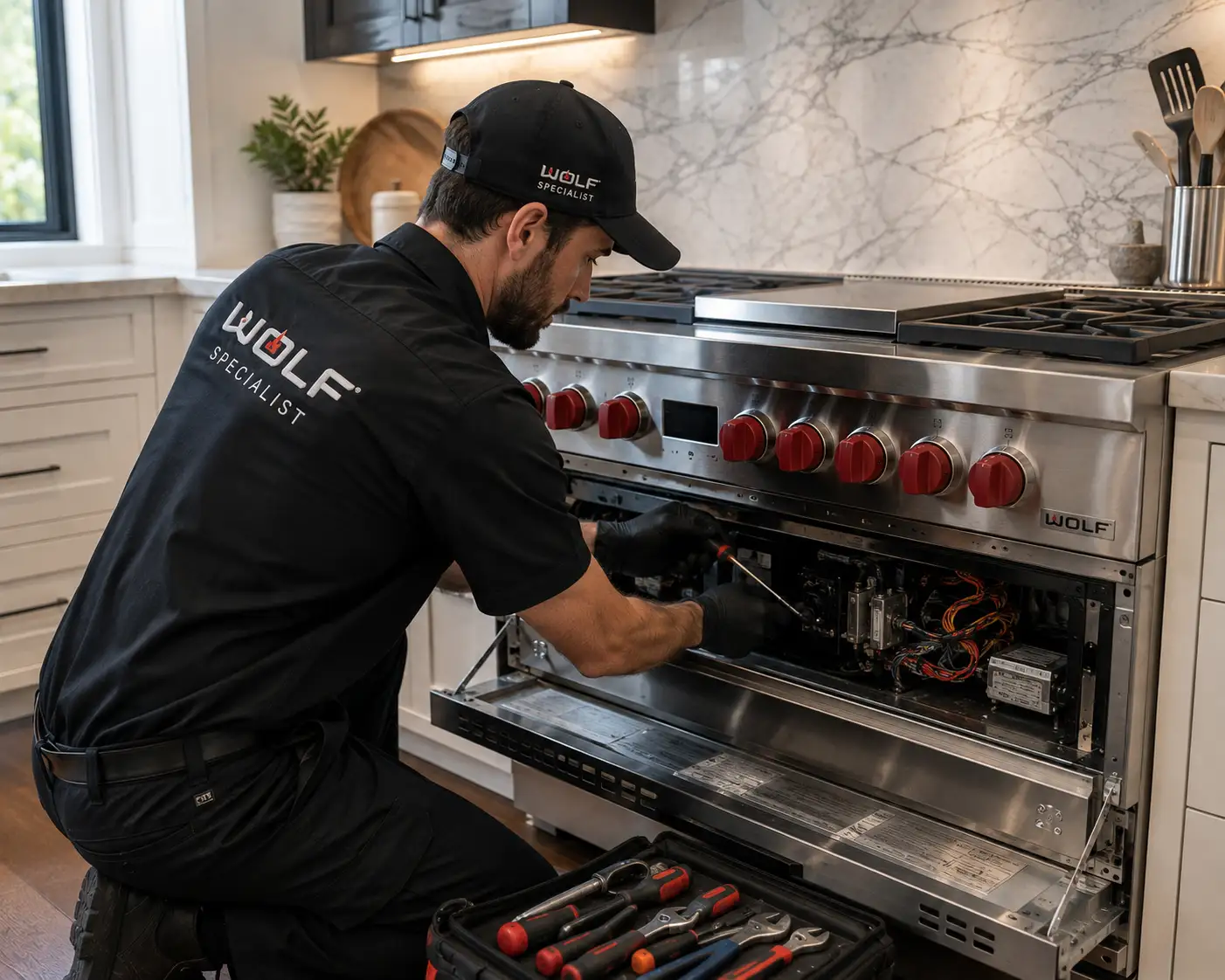
Wolf Appliance Repair by True Specialists
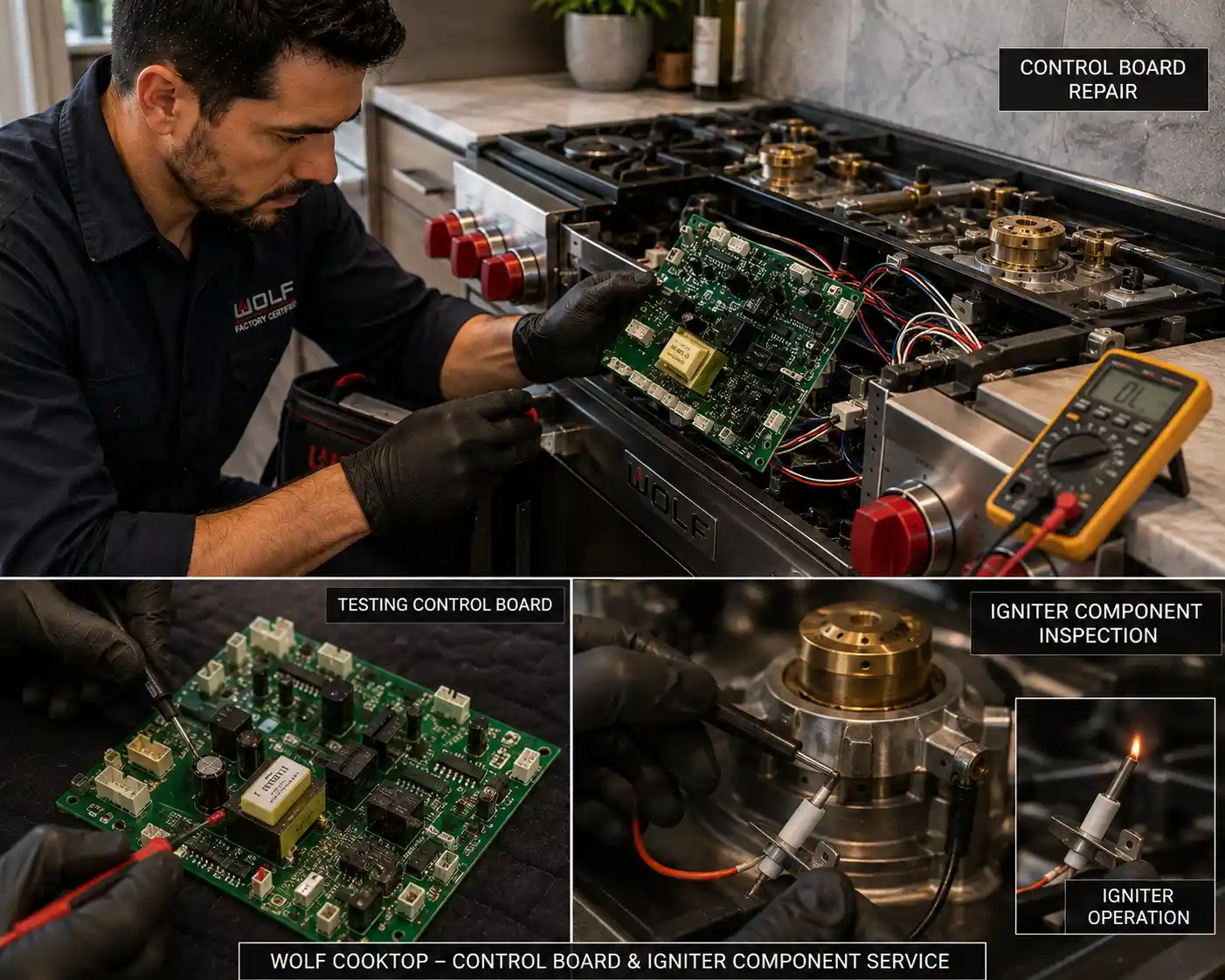
A Wolf range is built to outlast the kitchen around it, and most of the calls we get aren’t about a dying unit, they’re about one predictable part reaching the end of its life. A worn igniter, a failing temperature sensor, a door latch motor that’s stopped completing its cycle, none of that means anything is wrong with the range as a whole, it just means one component needs attention.
Wolf uses OEM parts that are specific enough that guessing gets expensive fast, and a generalist tech unfamiliar with the platform can misread a simple sensor fault as something bigger, or worse, install the wrong part entirely. We work on Wolf gas and dual fuel systems specifically, which means we can usually tell within minutes whether you’re looking at a quick fix or something that genuinely needs more attention.
Our approach is the same every time, diagnose first, explain what we found in plain language, then quote the actual repair before any work begins.
Wolf Appliances We Fix
Wolf makes several distinct cooking platforms, and each has its own quirks. Here’s what we service.
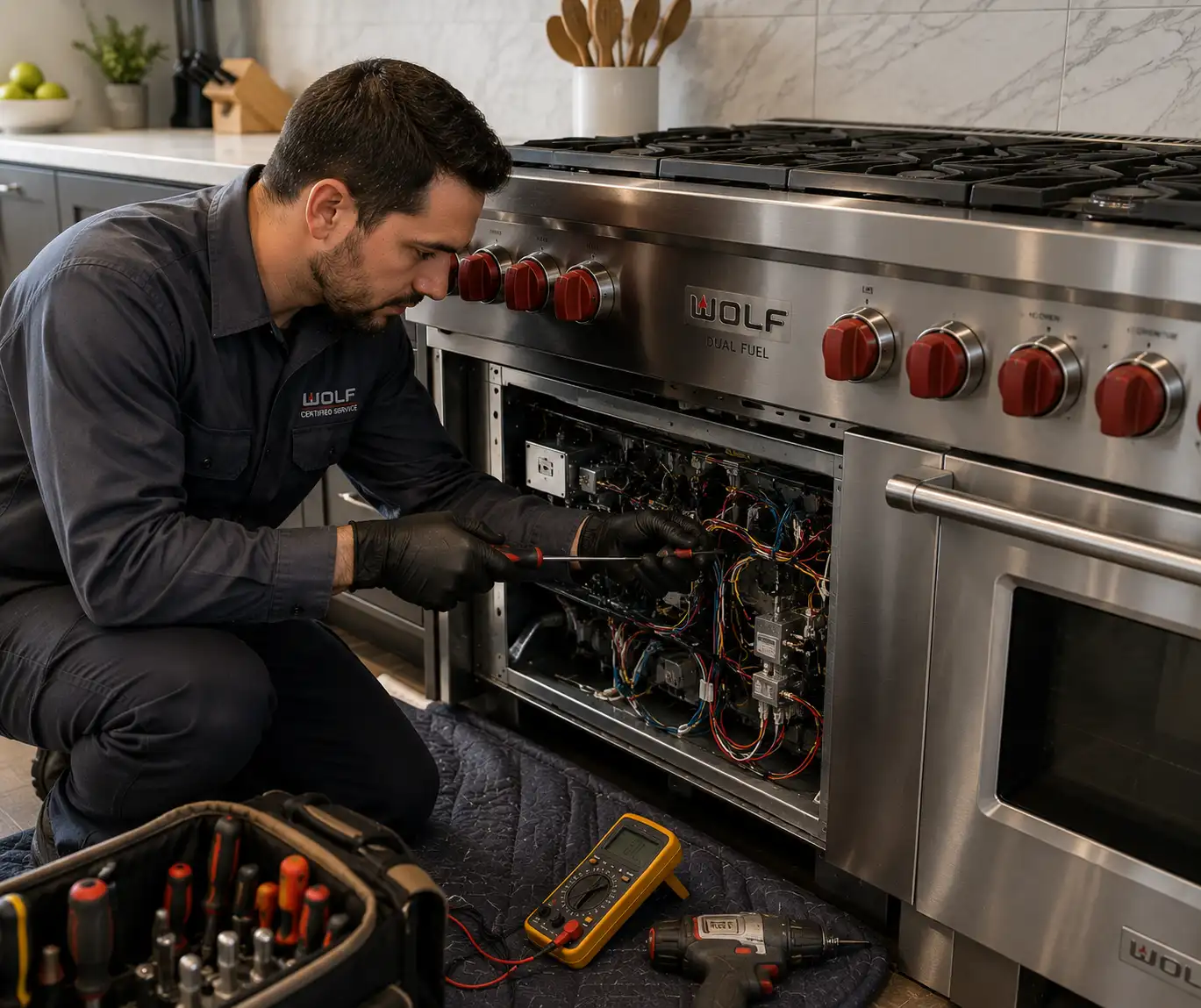
Dual Fuel Ranges
Gas cooktop paired with an electric convection oven, the most common Wolf configuration in Sarasota kitchens.
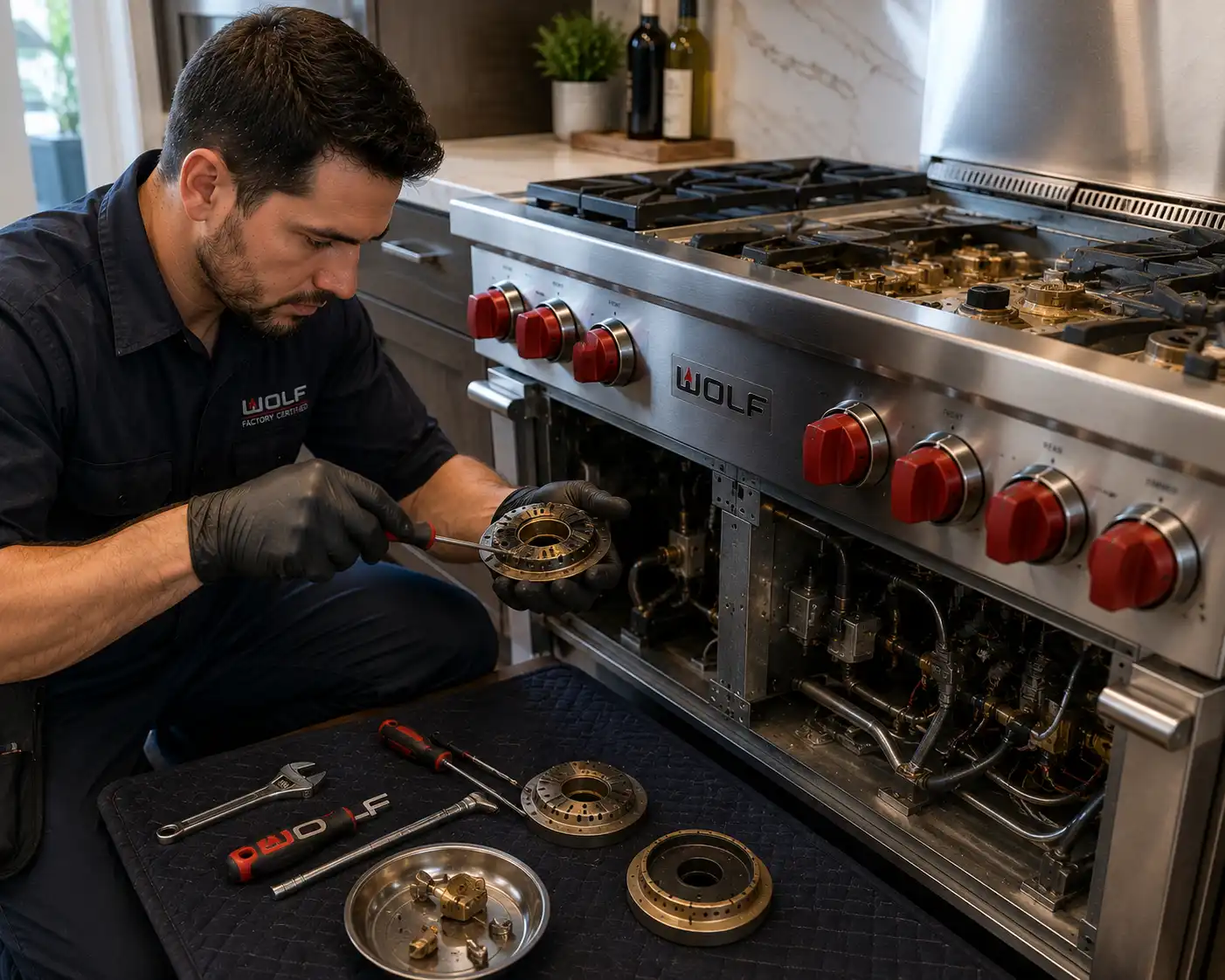
All Gas Ranges
Full gas ranges including sealed burner rangetops and pro style models.
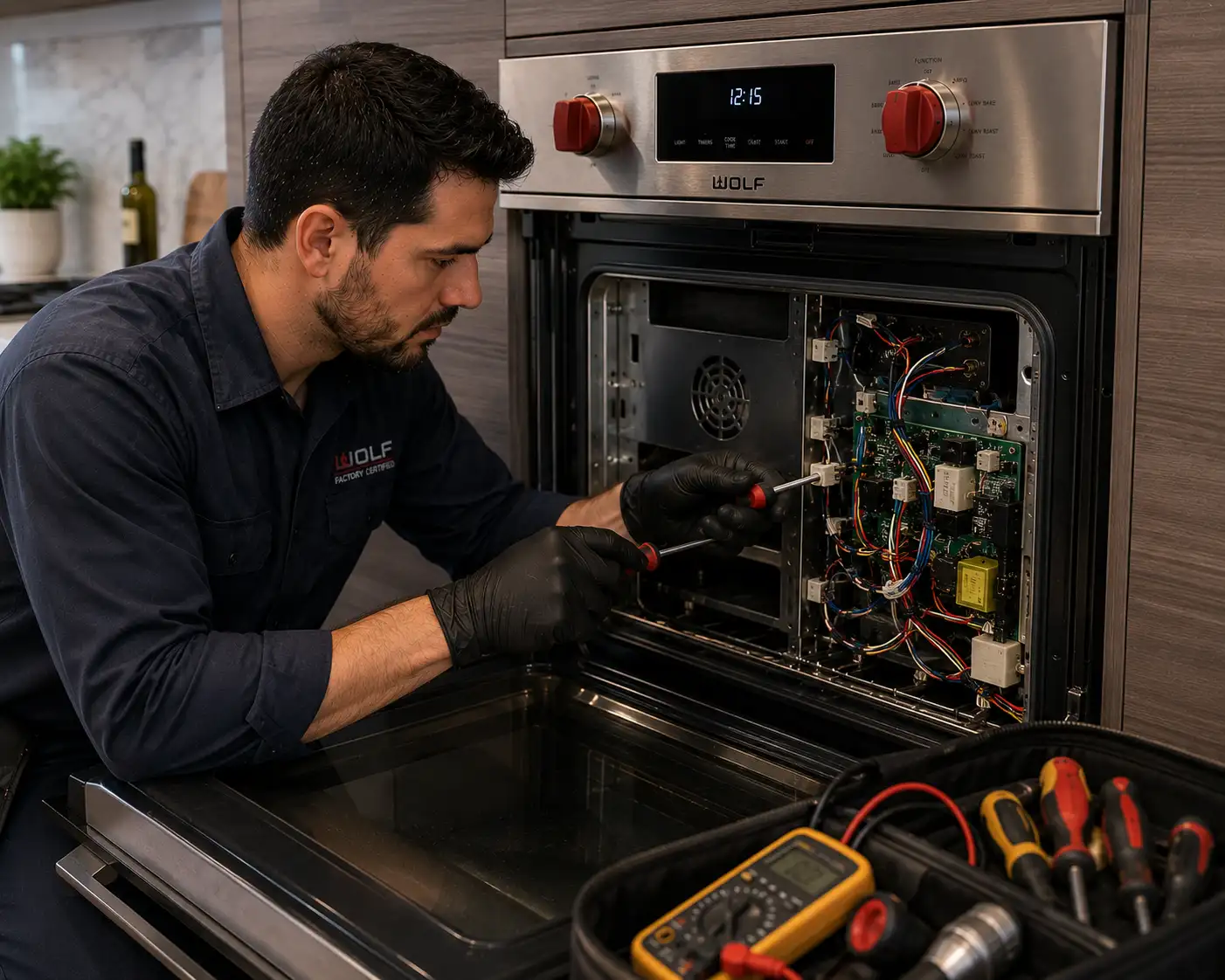
Built-In Wall Ovens
Single and double wall oven installations, including M Series models with electronic touch controls.
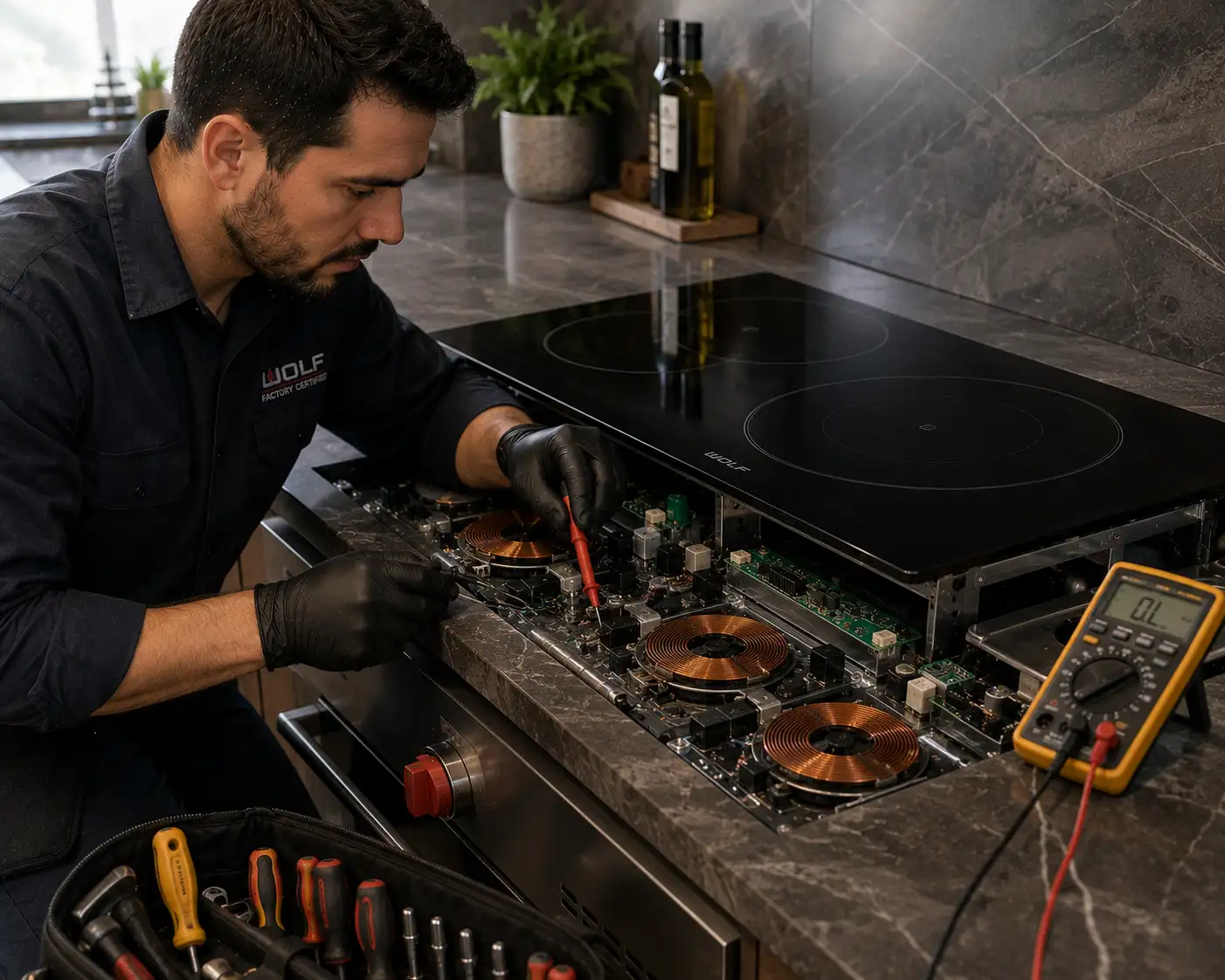
Induction & Electric Cooktops
CI Induction cooktops and electric cooktop models, including cookware compatibility and zone failures.
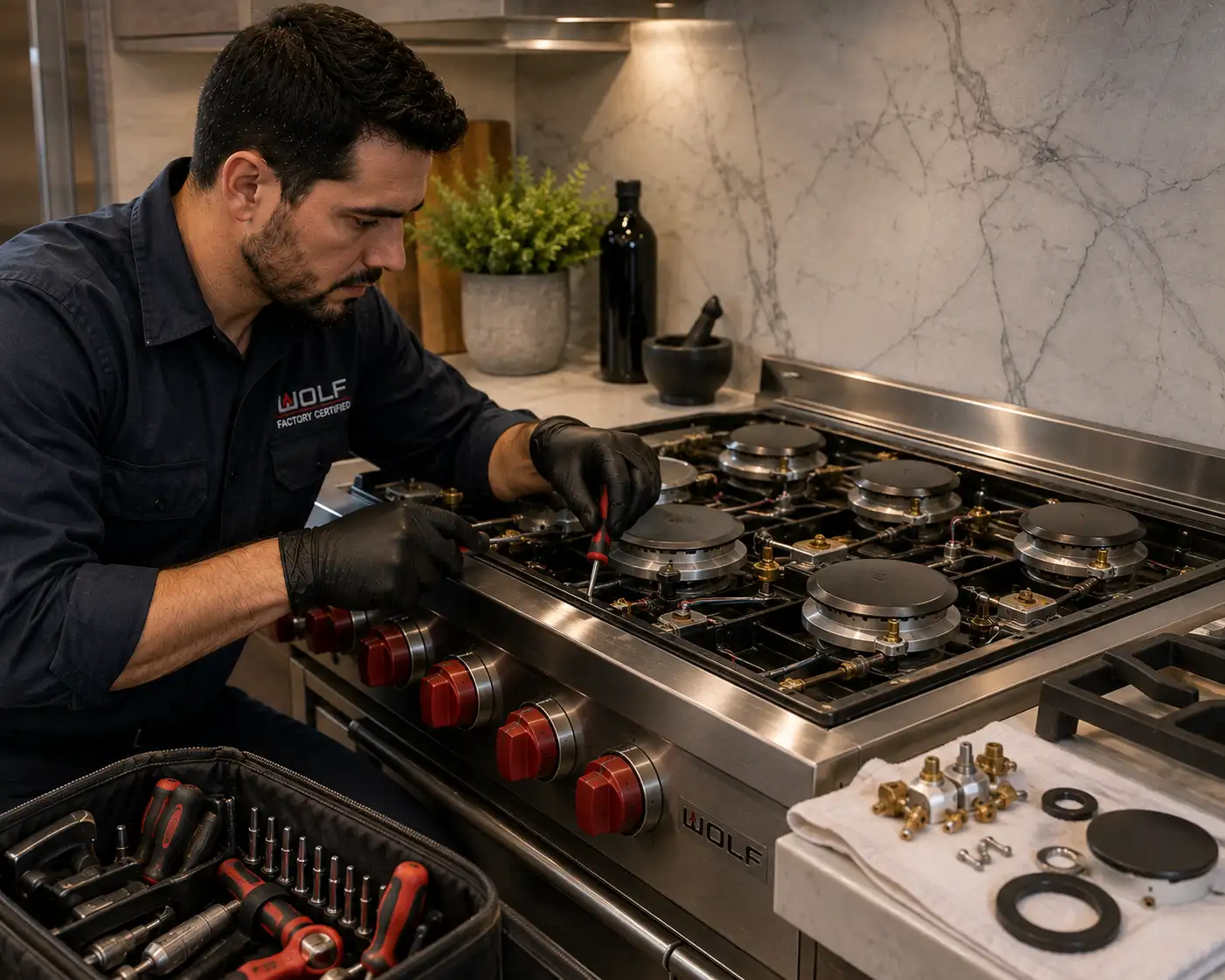
Sealed Burner Rangetops
Standalone gas rangetops installed separately from wall ovens, common in larger custom kitchens.
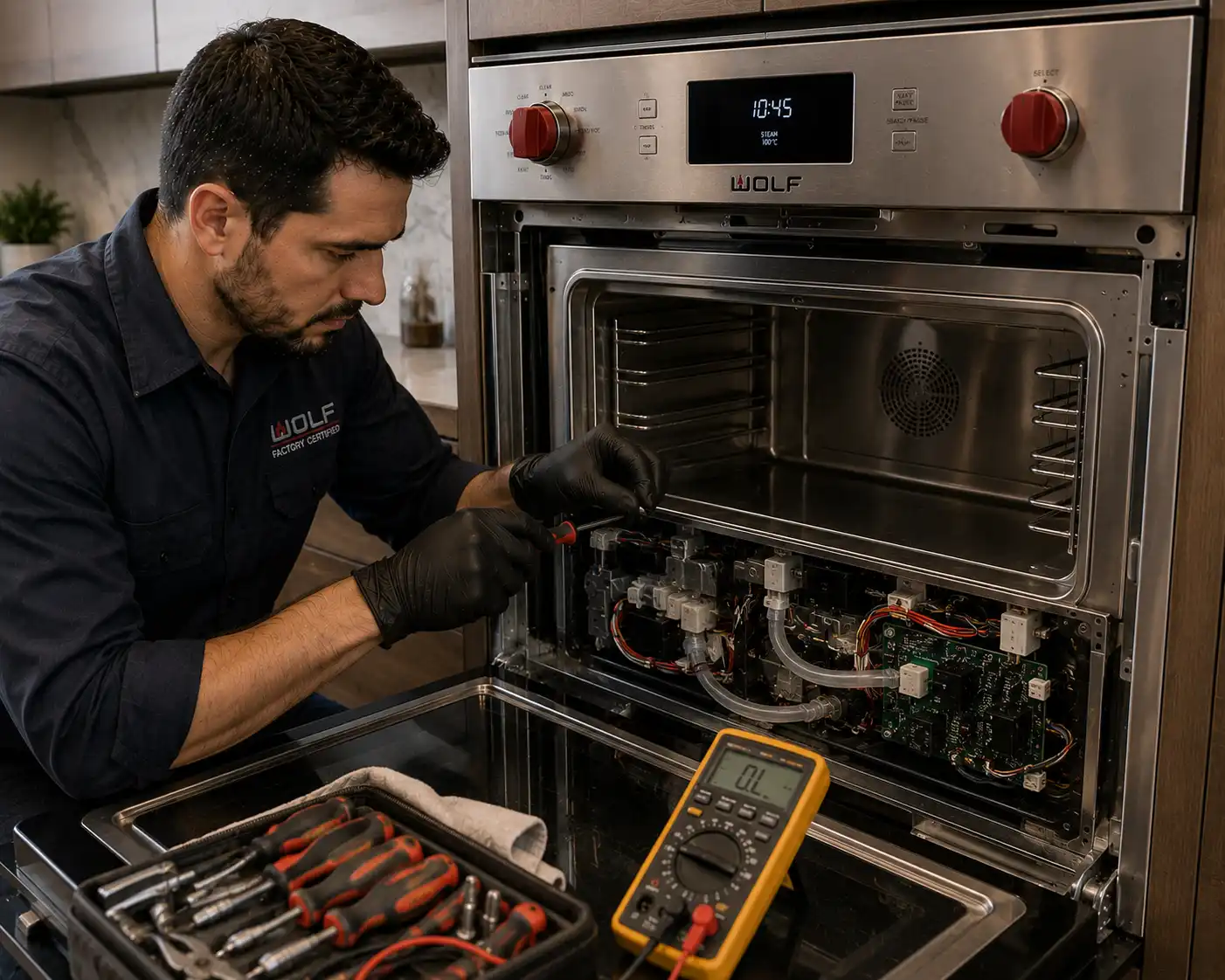
Steam & Convection Steam Ovens
Wolf steam ovens with their own distinct plumbing and sensor systems separate from standard ovens.
Common Wolf Problems & Error Codes
Wolf ranges and ovens display specific fault codes when something goes wrong, and burners have their own set of predictable failure points. Here’s what’s actually going on.
Oven & Range Error Codes
What it means: A temperature sensor open circuit, or on self-clean models, a door latch fault. F1 most often shows up after a self-clean cycle when the door has automatically locked and something in that process didn’t complete correctly.
Common cause: A failing door latch motor, or a temperature sensor that has an open connection. Cycling the breaker for 60 seconds sometimes clears it, but a repeat appearance usually means the part needs replacing.
What it means: Oven temperature runaway, the cavity has exceeded its safe temperature threshold and the system has cut off heating automatically to prevent a fire risk.
Common cause: A failing temperature sensor sending a bad reading to the control board, or a control board issue itself. This one should not be ignored or repeatedly reset, it’s a safety cutoff for a reason.
What it means: A shorted temperature sensor, the opposite failure mode from F1, where the sensor circuit is reading a short instead of an open connection.
Common cause: The RTD temperature probe itself has failed and needs replacement. Regular cleaning around the sensor area can help prevent this from happening prematurely.
What it means: A door latch motor fault on self-cleaning models, the motorized lock did not complete its travel within the expected window.
Common cause: Racks or debris obstructing the latch mechanism, or the latch motor itself wearing out after repeated self-clean cycles over the years.
What it means: An oven sensor fault, the sensor that works with the control board to regulate temperature fluctuations during cooking is no longer communicating correctly.
Common cause: A worn or failed oven temperature sensor. This is a straightforward and relatively inexpensive part once confirmed.
What it means: On dual-fuel double ovens, this displays when one oven is being operated while the other is running a self-clean cycle.
Common cause: Not actually a fault, this is a built-in safety limit to protect against excessive heat and power draw. It clears once the self-clean cycle finishes.
What it means: A communication failure between the display board and the internal control board on dual fuel models, or abnormal power routing to the relay board.
Common cause: A loose connection between boards, or in some cases the main control board itself needs replacing. This is one of the higher cost Wolf repairs, and worth a proper diagnosis before ordering parts.
Burner & Cooktop Issues
What it means: The igniter is sparking, so the electrical side is working, but gas isn’t lighting.
Common cause: Usually a fouled igniter electrode coated with boil-over residue, a misaligned burner cap, or leftover moisture in the igniter well from recent cleaning. This is one of the most common Wolf range calls we get, and often resolves without needing a part replaced.
What it means: The igniter isn’t sparking at all, which points to an electrical issue rather than a gas or cleaning problem.
Common cause: A tripped breaker, since gas ranges still need electricity to power the igniter, or the igniter itself has failed and needs replacement.
What it means: On Wolf CI Induction cooktops, this code means the cooktop cannot couple its magnetic field to the cookware sitting on it.
Common cause: Most of the time this is the cookware itself, not the cooktop, induction requires magnetic compatible pots and pans. Worth checking the cookware before assuming the unit needs repair.
A code narrows down where to look, it doesn’t replace a diagnosis. If an error code stays on the display, stop using the oven or range rather than continuing to reset it. Ongoing operation can put stress on internal components and, in the case of temperature related codes, create a real safety risk.
Gas, Dual Fuel, and Induction, What’s Different
Wolf builds across three distinct platforms, and knowing which one you have changes what typically fails and how it gets fixed.
Both the cooktop and oven run on gas. Igniters are the most common point of failure on the burners, and the oven side uses a gas igniter as well rather than an electric element, which means a slow preheat or an oven that won’t heat often traces back to that igniter rather than a sensor or board.
The most common Wolf configuration, gas burners on top paired with an electric convection oven below. This setup gives you gas cooking control with more precise electric oven temperature, but it also means two separate systems to diagnose, a burner issue and an oven issue rarely share the same root cause on a dual fuel unit.
No open flame and no gas igniter, induction cooktops use magnetic fields to heat cookware directly. Most “not heating” calls on induction units turn out to be a cookware compatibility issue rather than an actual cooktop fault, magnetic induction requires specific pot and pan materials. Genuine faults usually point to the induction coil or the control module underneath the glass surface.
Wolf Repair Pricing in Sarasota
Wolf units use higher grade OEM components, and pricing reflects that. Real ranges below, exact pricing confirmed on site before any work begins.
| Repair Type | Typical Cost Range |
|---|---|
| Diagnostic / Service Call | $99 – $150 (waived if you approve the repair) |
| Burner Igniter Replacement | $150 – $300 (parts and labor) |
| Oven Temperature Sensor Replacement | $180 – $320 |
| Door Latch Motor Replacement | $250 – $450 |
| Door Gasket / Seal Replacement | $150 – $300 |
| Bake Element Replacement | $200 – $400 |
| Induction Module / Coil Repair | $300 – $600 |
| Control Board Replacement | $350 – $700 |
Is Your Wolf Worth Repairing?
Most Wolf range faults are worth repairing. A handful of specific situations are the honest exception. Here’s how to tell which one you’re looking at.
- Igniter replacement, burner or oven side
- Temperature sensor or RTD probe failure
- Door latch motor or gasket replacement
- Bake element replacement on dual fuel models
- Any single component failure on a unit under 10 years old
- Control board failure paired with a second major fault
- A cracked inner or outer glass panel on an older unit
- Repeated F2 over-temperature faults on an aging unit
- Repair quote approaching the cost of a comparable new unit
Why Wolf Units Are Usually Worth Fixing
Wolf ranges are built to outlast the kitchens they sit in, and a unit entering its tenth year is generally entering its prime service window rather than the end of its life. Most of what fails, igniters, sensors, latch motors, are individual parts doing their job, and replacing one doesn’t say anything about the health of the rest of the unit. A cracked glass panel or a control board issue on a much older unit is where the conversation genuinely shifts, and we’ll always tell you honestly which side of that line your repair falls on.
Wolf Gas Safety, What’s Safe to Check Yourself
Most igniter and burner issues have a simple explanation. A few situations cross the line into something a technician needs to handle.
Never work on a gas line, gas valve, or igniter module yourself
A small gas leak or a miswired burner element is a real fire and carbon monoxide hazard. Wolf OEM parts are specific enough that guessing gets expensive, and gas line work should always be handled by a licensed technician.
What’s genuinely safe to check yourself?
Cleaning burner caps, burner ports, and igniter electrodes is safe homeowner work. Checking that the range is plugged into a working outlet without an extension cord, and checking your circuit breaker, are also fine, gas ranges still need electricity to power the igniter.
My burner clicks but won’t light. Is that dangerous?
Not typically. A clicking igniter with no flame usually means a fouled electrode or leftover moisture rather than a gas supply issue, and it’s one of the most common Wolf calls we get. Give it time to air dry after cleaning before assuming it needs a part replaced.
What should I do if I smell gas?
Turn off the burner or oven, and if the smell persists, shut off the gas supply at the source and ventilate the area. A persistent gas smell that doesn’t clear after shutting off the appliance is not something to keep troubleshooting yourself, it needs a technician or your gas utility provider right away.
Wolf Repair Questions, Answered
Specific questions about Wolf repair in Sarasota. For general questions about our service, check our main FAQ page.
Why does my Wolf burner click but not light?
What does the F1 error code mean on my Wolf oven?
Why does my Wolf oven show an F2 code and stop heating?
How much does Wolf repair typically cost?
Is it worth repairing an older Wolf range?
My induction cooktop shows an E6 error with a pan on it. What does that mean?
Why is my Wolf oven taking forever to preheat?
Is it safe to replace a Wolf igniter myself?
What is the OPP code on my Wolf dual-fuel double oven?
Why is my Wolf range not turning on at all, even though it’s gas?
Can Wolf repairs be done same day?
What should I do if I smell gas near my Wolf range?
Why does my Wolf oven have uneven heating or hot spots?
Is a landlord or tenant responsible for Wolf appliance repairs in Florida?
Get Your Wolf Fixed Today
Tell us what it’s doing and we’ll get a technician out fast. No obligation, no pressure, just a straight answer and a fair price.
Fill out the form. One of our reps will reach out to get your inspection scheduled.