Why Is My Refrigerator Not Cooling in Sarasota Humidity?
A refrigerator stops cooling in Sarasota most often because of dirty condenser coils, a failed fan, blocked airflow, or a worn door seal. Our humidity and salt air make all four happen sooner. Start with the power and the temperature setting, then clean the coils and clear the vents. If the fridge is still above 40°F a day later, or you hear clicking or humming with no cooling, call a technician and move your food to a cooler.
We repair refrigerators across Sarasota every week, from Siesta Key condos to Palmer Ranch homes. This guide walks through what we check on a service call, what you can safely try yourself, what it costs, and when it is time to stop and call us.
How do I know my refrigerator is really not cooling?
Do not trust how the inside feels. Put an appliance thermometer in a glass of water on the middle shelf and leave it for several hours. The fridge should read 40°F or lower, and about 37°F is a good target. The freezer should sit at 0°F.
These signs also point to a cooling problem:
- Milk or leftovers spoil before the date
- Condensation or water droplets on packaged food
- Ice cream that stays soft
- A motor that runs nonstop but the box never gets cold
- Frost or ice where you did not have it before
After you change a setting or clean something, give the fridge 24 hours before you decide whether the fix worked. A fridge needs time to pull itself back down.
Is my food still safe in a refrigerator that stopped cooling?
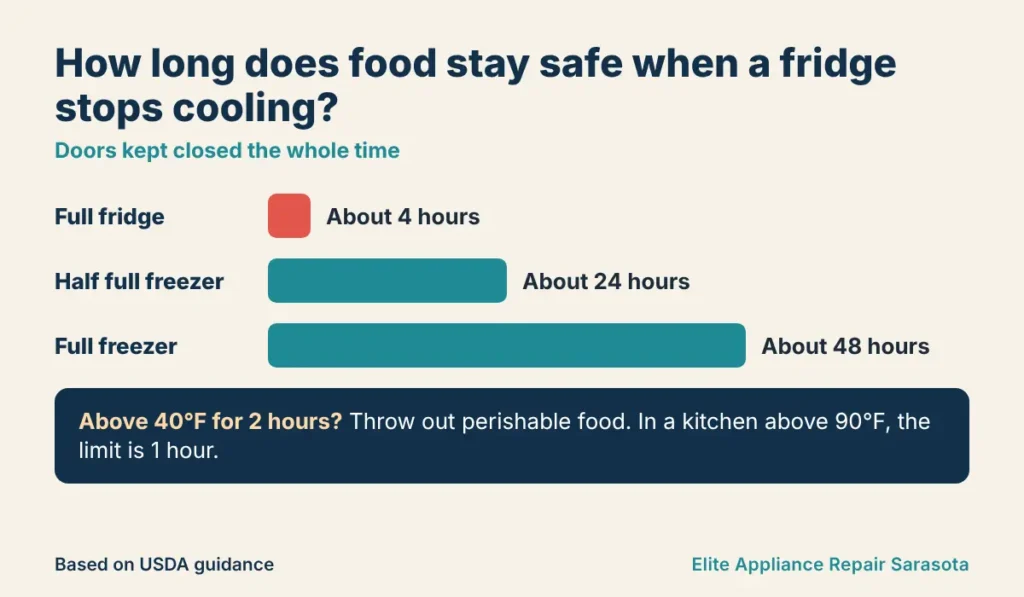
According to USDA guidance, perishable food that sits above 40°F for more than 2 hours should be thrown out. If your kitchen is above 90°F, that window drops to 1 hour. In a Sarasota summer, treat the shorter window as the safe one.
With the doors kept shut, a full fridge holds a safe temperature for about 4 hours. A full freezer holds for about 48 hours, and a half full one for about 24. Every time you open a door, you shorten that time.
While you wait for a fix:
- Keep the doors closed as much as you can
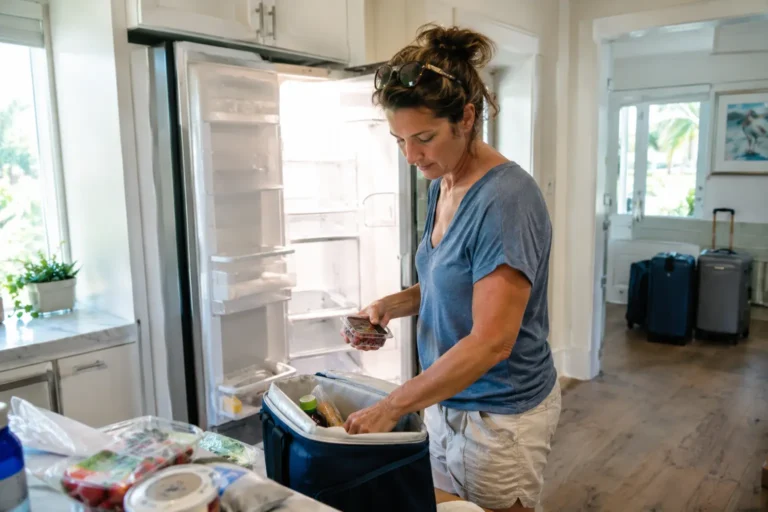
- Move milk, meat, and leftovers to a cooler with ice
- Never taste food to test it
Throw out raw meat, poultry, fish, eggs, dairy, cut fruit, cooked leftovers, and anything that smells off. Hard cheese, butter, whole fruit and vegetables, and most condiments usually survive a warm day. When you are not sure, throw it out.
Why does Sarasota humidity make refrigerators stop cooling?
A refrigerator moves heat out of the box and into your kitchen. Sarasota makes that job harder in several ways, and each one shows up in our repair calls.
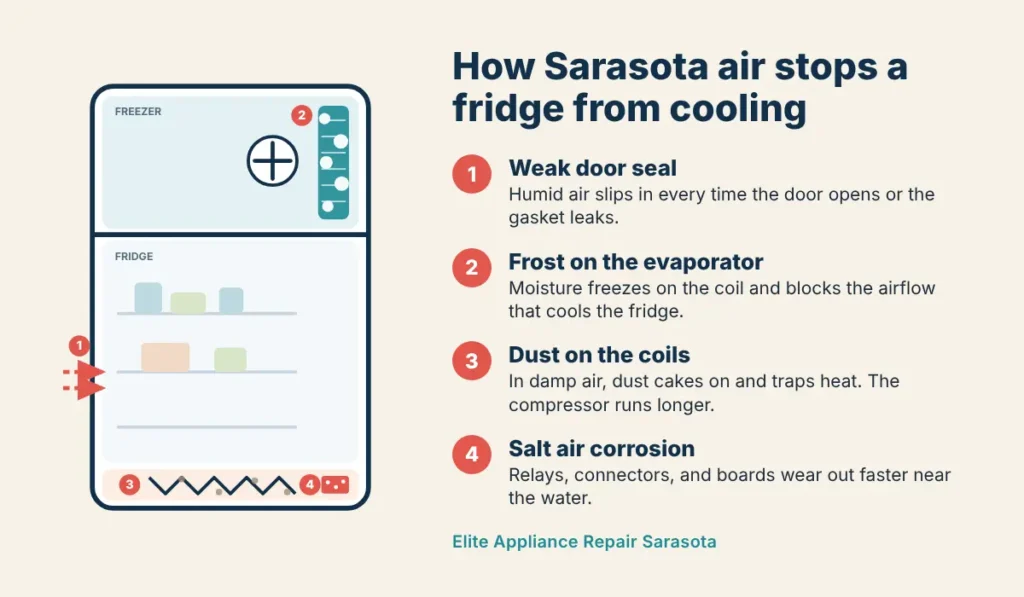
- Moist air gets in. A weak door seal lets humid air into the fridge. That moisture freezes on the evaporator coil, builds a layer of frost, and blocks the airflow that carries cold into the fresh food section.
- Dust holds moisture. Dirty condenser coils trap heat, and in damp air the dust cakes on. The compressor runs longer and wears out sooner.
- Salt air corrodes parts. Near the Gulf and the bay, salt in the air eats at coil fins, wire connectors, relay contacts, and control boards.
- Hard water scales water parts. Water valves and ice maker lines clog with mineral buildup, which can leave a fridge leaking or acting up.
- Garages and lanais are rough on fridges. A second refrigerator in a hot garage or on a covered lanai can pass its operating limits in summer. Check the temperature range in your manual.
- The kitchen runs hot. When the AC cycles and the oven runs, the fridge has to work harder to shed heat.
Homes in Siesta Key and Longboat Key are where we see the salt air effect most.
What should I check first before I call a repair company?
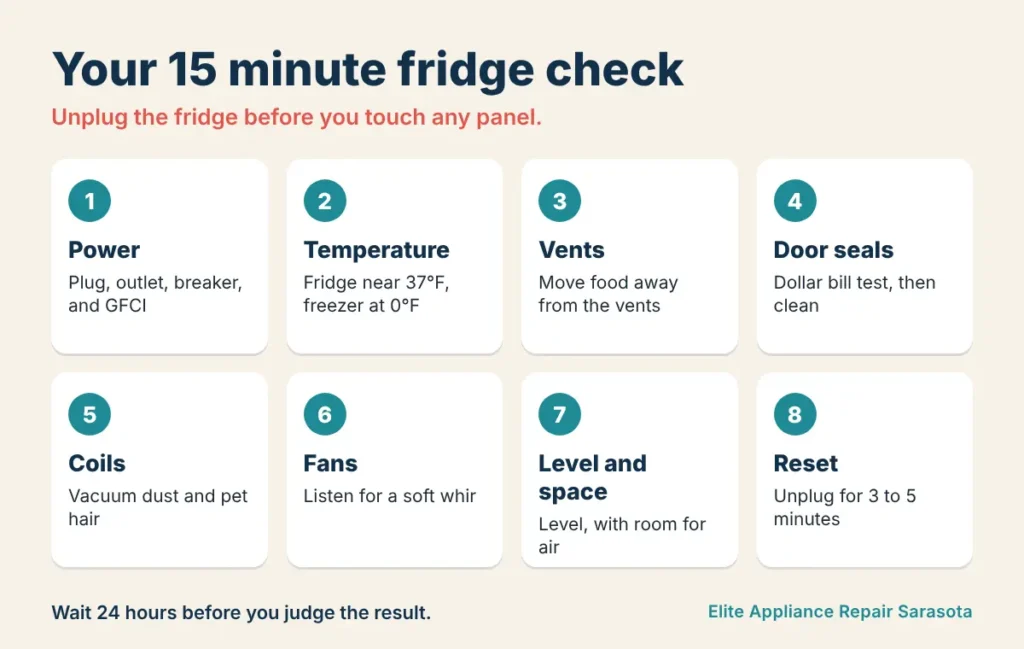
These checks take about 15 minutes and fix more calls than you would expect. Unplug the fridge before you touch anything behind a panel.
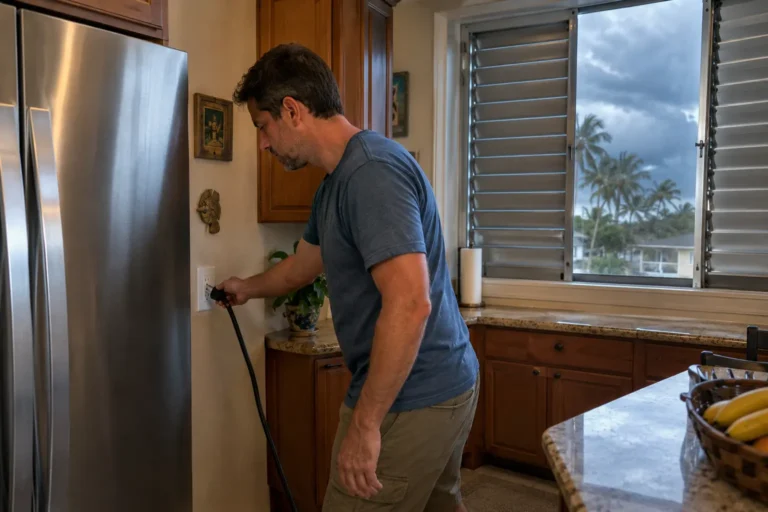
- Power. Check the plug, the outlet, and the breaker. A tripped breaker or GFCI looks exactly like a dead fridge. See if the inside light comes on.
- Temperature setting. Controls get bumped by a hand or a grocery bag. Set the fridge near 37°F and the freezer to 0°F. Check both controls, since many models have two.
- Vents. Move food away from the vents inside the fridge and the freezer. An overpacked shelf blocks cold air.
- Door seals. Close a dollar bill in the door. If it slides out easily, the seal is not gripping. Clean the gasket with warm soapy water and dry it.
- Coils. Look at the coils behind the bottom grille or on the back. If they are coated with dust or pet hair, clean them as described in the next section.
- Fans. Listen near the back wall of the freezer and by the compressor. You should hear a soft whir. Silence or a rattle points to a fan.
- Level and space. The fridge should sit level with room around it for air to move. Your manual lists the exact clearance.
- Reset. Unplug the fridge for 3 to 5 minutes and plug it back in. Then wait the full 24 hours before judging.
Write down what you see and hear, plus any error code. It saves time on the visit.
What are the most common reasons a refrigerator stops cooling?
These are the causes we find most often, listed from the easiest to fix to the hardest.
Dirty condenser coils
The coils release heat from the sealed system. When dust and pet hair cover them, heat stays in and the compressor works nonstop. Unplug the fridge, vacuum the coils with a brush attachment, and clear the space around them. In Sarasota, do this about twice a year.
A failed condenser or evaporator fan
The condenser fan cools the compressor and coils. The evaporator fan pushes cold air from the freezer into the fresh food section. A dead fan gives you a warm fridge, a noisy cabinet, or both. A fan motor swap is a job for a technician.
Blocked vents and an overpacked fridge
Cold air needs a path. Boxes pushed against the back wall or stacked in front of vents stop it. Open up the shelves and the temperature often drops within a day.
Worn or dirty door seals
A cracked or dry gasket lets warm, wet air in all day. You may see sweat along the door edge or frost near the seal. Cleaning helps a dirty seal. A torn one needs replacing.
A defrost system failure and frost buildup
A fridge defrosts itself on a schedule using a heater, a sensor, and a timer or board. When one part fails, ice builds on the evaporator coil and blocks airflow. A thick layer of frost on the back wall of the freezer is the classic sign. Do not chip it away. Unplugging the unit to melt it only buys you a few days.
A bad start relay or control board
The start relay gives the compressor its kick. When it corrodes or fails, you may hear a click, then a hum, then silence, and the fridge never cools. Humid coastal air is hard on these parts. A control board can also fail from a power surge and leave the fridge dead or confused.
A compressor or sealed system problem
This is the costliest cause and the least common. A compressor that runs loudly, never stops, or trips the breaker needs a professional. Work on the sealed system requires a technician certified to handle refrigerant. Most of the time, we find one of the causes above first.
Why is my refrigerator warm but my freezer still cold?
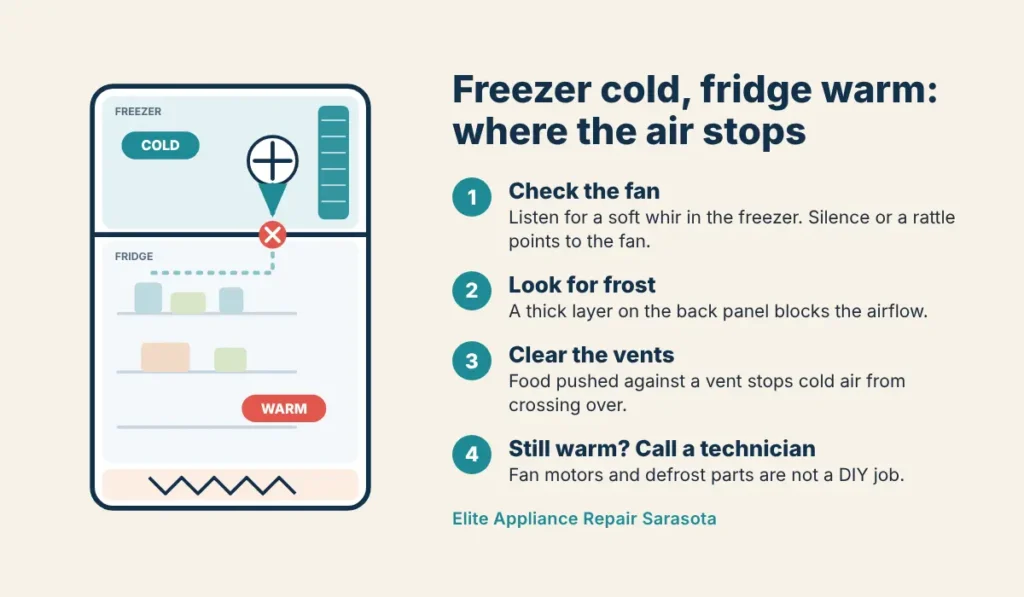
The freezer makes the cold. A fan then moves part of that air through vents into the fresh food section. If the freezer is cold and the fridge is warm, the cold is being made but it is not getting across.
The usual causes are a failed evaporator fan, a frozen evaporator coil, a stuck air damper, or vents blocked by food. The compressor is rarely the problem, because a working compressor is what keeps the freezer cold.
Open the freezer and listen for the fan. Look for frost on the back panel and check that nothing blocks the vents. If the vents are clear and the fan is quiet or the back wall is iced over, you need a technician. This is often a one visit repair.
Why did my refrigerator stop cooling after a storm or power outage?
Power surges are the leading cause we see after Sarasota storms. A surge can damage the control board or leave the fridge in a lockout mode where it will not start. Short outages can also leave the compressor unable to restart.
During an outage, keep the doors closed. After the power returns:
- If you unplugged the fridge, wait 5 minutes before you plug it back in. Do not switch it on and off repeatedly.
- Check the display for an error code and write it down.
- Give it 24 hours to pull down to temperature, then check it with a thermometer.
- Use the food safety rules above before you eat anything.
If water reached the base of the fridge, do not plug it in. Water near the compressor and wiring is a shock hazard, and the unit needs an inspection first. For storm prep that protects your kitchen before the next one, read our hurricane appliance care guide. A surge protector made for appliances is a cheap safeguard.
Why did my refrigerator stop cooling after I came back from summer away?
A fridge that sat for months often fails the first time you run it again. Door seals dry out and crack, water lines leave deposits or leak, and the compressor can struggle to start after sitting idle. Mold also grows quickly inside a closed fridge in Florida.
When you return:
- Clean the inside and wipe the door seals
- Vacuum the coils before you start the fridge
- Plug it in empty and wait 24 hours before you load it
- Check the water line and filter for leaks
- Throw out the first few batches of ice
If it still does not cool, call us before you stock it. Our guide on why appliances fail when you return covers the rest of the kitchen, and the checklist for leaving for the season helps you avoid the problem next spring.
How can I tell what is wrong from the symptom?
Use this table as a starting point. A technician confirms the cause on site before any work starts.
| What you notice | Likely cause | DIY or professional | Typical cost in Sarasota |
| Dead fridge, no light | Outlet, breaker, or control board | Power check is DIY, board is professional | Free to check, board is mid to high range |
| Runs nonstop, fridge is warm | Dirty coils or a failed condenser fan | Coils are DIY, fan is professional | Coil cleaning is free, fan motor about $150 to $400 |
| Fridge warm, freezer cold | Evaporator fan, frozen coil, or blocked vents | Clear vents first, then professional | Fan motor about $150 to $400 |
| Thick frost on freezer back wall | Defrost heater, sensor, or board | Professional | Within our $150 to $450 range for most repairs |
| Click, hum, then silence | Start relay or compressor | Professional | Relay within $150 to $450, compressor $700 to $1,000 or more |
| Sweat or frost at the door edge | Worn or dirty seal | Cleaning is DIY, replacing is professional | Door gasket $120 to $250 |
| Stopped after a storm, error code | Surge damage or lockout | Wait, then professional | Board is mid to high range |
The fan motor range is a national average. The other figures are our Sarasota ranges. The diagnostic fee is separate and is waived when you approve the repair.
Which refrigerator brands have the most common not cooling problems?
Every brand can lose cooling, but we see patterns. These come from our own repair calls, so treat them as tendencies, not rules.
- GE: evaporator fan motors, which cause warm spots or a rattle
- Whirlpool: ice maker assemblies, the most frequent failure on these
- LG: compressors, so check your extended warranty before you pay
- Samsung: compressors
- Frigidaire: control boards and sensors that cause temperature swings or error codes
- Sub-Zero: sealed system wear on older units
Before you pay for any repair, look at your warranty paperwork. If the fridge is still under the manufacturer warranty, the work usually has to go through their authorized service network. We tell you up front if your unit is covered so you can choose.
What can I fix myself, and when should I stop?
These are safe to try on your own. Unplug the fridge when you work near any parts:
- Reset the temperature setting
- Clean the condenser coils
- Clear the vents and loosen an overpacked shelf
- Clean the door seals
- Level the fridge
- Unplug it for a few minutes to reset it
Stop and call a technician if you notice any of these:
- A burning smell, smoke, or a breaker that keeps tripping
- Water near the plug or the wiring
- A compressor that is loud, hot, or never shuts off
- A control board that shows codes or acts oddly
- Frost behind the freezer panel
- Anything that involves refrigerant
Refrigerant work needs a technician with EPA certification for sealed systems, and live electrical parts can hurt you. Taking off panels without knowing the unit can also turn a small repair into a bigger one.
How much does it cost to fix a refrigerator that is not cooling in Sarasota?
Most refrigerator repairs in Sarasota run between $150 and $450, depending on the part. These examples come from our refrigerator repair page:
- Diagnostic visit: $45 to $165, waived when you approve the repair
- Door gasket: $120 to $250
- Compressor replacement: $700 to $1,000 or more
Premium built in brands such as Sub-Zero cost more because of proprietary parts and harder access. The final price depends on the part, the brand, and the age of the unit, and we confirm it on site.
Many companies charge by the hour and add parts later, so you do not know the total until the job is done. We quote one flat price for parts and labor before we start. If you decide not to go ahead, you pay only the diagnostic fee.
Should I repair or replace a refrigerator that will not cool?
A good rule is the 50 percent rule. Repair the fridge when the quote is under half the price of a new one and the unit is under 8 to 10 years old. A single failed part is a good sign for repair.
Replace it when:
- The quote is close to half the price of a new fridge
- The fridge is past 10 to 12 years old
- It has needed three or more repairs in two years
- The sealed system or compressor has failed on an older unit
Here are two examples. A $375 repair on a newer fridge makes sense, because you are fixing one part on a unit with years left. A $645 quote on a 12 year old fridge with earlier repairs is a harder call, and replacing it is often the smarter spend.
Premium and built in models are the exception. A fridge that costs thousands to replace is often worth repairing well past the 50 percent line. We give you a straight number on the spot, and if replacing makes more sense, we say so.
How do I keep a refrigerator cooling in Florida?
- Vacuum the condenser coils about every 6 months
- Wipe the door seals every month and replace them when they crack
- Leave room around the fridge for airflow, as your manual describes
- Keep the fridge level
- Do not overpack the shelves or block the vents
- Keep the thermometer reading near 37°F in the fridge and 0°F in the freezer
- Plug the fridge into a surge protector before storm season
- Avoid running a second fridge in an open garage if you can, or check its temperature range first
- Before you leave for the season, follow our leaving season checklist
What happens during a refrigerator repair visit, and how do I prepare?
Here is how a visit works with us:
- You call or book online, and we give you a same day or next day window.
- The technician diagnoses the fridge on site and gives you the price before touching anything.
- If you approve, we fix it that visit whenever the part is in stock. Parts and labor are included in the price.
You get a written diagnosis and photos of the actual fix. You can read more on our process page.
Before we arrive:
- Clear a path to the fridge and room to pull it out
- Move food to a cooler
- Have the model and serial number ready, from the label inside the fridge
- Write down noises, codes, and when the problem started
- Find your warranty papers if the fridge is fairly new
A real Sarasota repair: refrigerator not cooling, failed start relay
On a recent Sarasota call, a refrigerator had stopped cooling. The cause was a corroded compressor start relay that had failed. We replaced it the same day.
This is the kind of problem humid coastal air creates. It is easy to assume a warm fridge means a dead compressor, but a proper diagnosis tells you which part has failed before you spend money.
Refrigerator not cooling questions, answered
How long can food stay in a refrigerator that stopped cooling?
A closed, full fridge stays cold enough for about 4 hours after cooling stops. Once perishable food has been above 40°F for 2 hours, throw it out. In a kitchen above 90°F, the limit is 1 hour.
Why is my fridge not cooling but the freezer is fine?
The cold is being made in the freezer but is not reaching the fridge. The usual causes are a failed evaporator fan, a frozen evaporator coil, or blocked vents. A technician can usually fix this in one visit.
How often should I clean refrigerator coils in Florida?
About every 6 months. Do it more often if you have pets or the fridge sits in a dusty or hot spot.
Can humidity really stop a refrigerator from cooling?
Humidity alone rarely does it. But damp, salty air speeds up the real causes: frost on the evaporator, clogged coils, corroded relays and boards, and worn seals.
Will resetting my refrigerator fix it?
Sometimes. If a setting was bumped or the board glitched, unplugging the fridge for 3 to 5 minutes can help. Wait 24 hours before you judge it. If the problem comes back, a part has failed.
Is it worth repairing a refrigerator that will not cool?
Usually yes, when the fridge is under 8 to 10 years old and the quote is under half the price of a new one. Premium built in units are worth repairing at higher costs.
Is a garage refrigerator more likely to stop cooling in Florida?
Yes. Summer heat and humidity in a garage push a fridge past what it was designed for. Check your manual for its temperature range, and move it indoors if you can.
Does my warranty cover a refrigerator that stopped cooling?
Possibly. Look at the manufacturer warranty and any extended coverage, especially for compressors on LG and Samsung models. If you are under warranty, repairs usually go through the manufacturer authorized service network. We tell you up front.
Can you fix my refrigerator the same day?
Most calls in Sarasota get same day or next day service. Call before noon and we can often be there that afternoon.
Need your refrigerator fixed today?
If your fridge is warm and the checks above did not help, call Elite Appliance Repair Sarasota at (941) 430 8787 or book online. We give you the price before we start and finish most repairs in one visit. You can also read about our full refrigerator repair service in Sarasota.